
jatszoter
jatszoter is a self-hosted, open-source training and exam stand for Linux troubleshooting, in the spirit of SadServers. An operator starts a deployment: a VM on one of the agents, bootstrapped from a scenario that installs, configures and then breaks something. The operator watches the VM terminal, hands it to a trainee through a unique link, can take control back at any moment, and a check script decides whether the trainee fixed the problem. Every terminal session is recorded for replay.
Demo
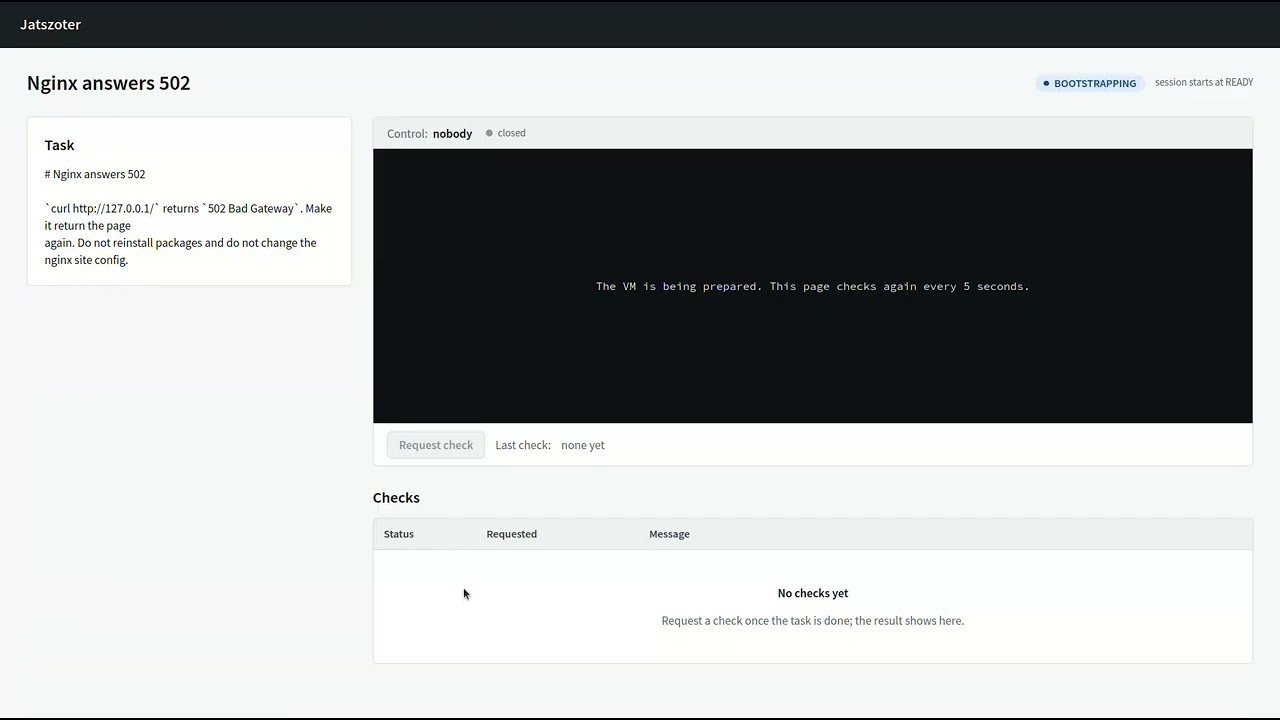
Demo #1 walks one full cycle on the
nginx-502 scenario: a trainee and a deployment are created, the VM
bootstraps, the trainee fixes the 502 in the terminal and the check passes,
then the operator stops the deployment and purges its logs.
Components
packages/api- the control plane, FastAPI over SQLModel: agents, leases, scenarios, deployments, links, recordings and checks.packages/agent- the host daemon in Rust: leases deployments, runs up to N QEMU VMs, bootstraps them with cloud-init and ships their consoles.packages/web- the operator and trainee UI: FastAPI, Jinja2, HTMX and xterm.js.
How they fit together is in docs/project/01-architecture.md.
Repository layout
| Path | What it holds |
|---|---|
packages/ |
api, agent, web and shared Python code |
scenarios/ |
scenarios, one directory each |
docs/ |
project documentation and its GitHub Pages site |
docker/ |
container images of api and web |
prompts/ |
step-by-step implementation prompts |
dev/web/ |
Penpot mockups of the Web UI |
Requirements
On a Debian or Ubuntu workstation:
sudo apt install python3 python3-venv make docker.io docker-compose-v2 shellcheck
Rust comes from rustup; cargo fmt and cargo clippy
run as pre-commit hooks. hadolint is
a single binary on PATH.
Development
make install
make shell
make lint
make install builds .venv, installs the pinned tools and the git hooks.
make shell opens a shell inside that venv. make lint runs every
pre-commit hook over the tree.
The Web UI is designed before it is built: see dev/web/README.md.
Contributing
Read CONTRIBUTING.md before you open a pull request, and follow the Code of Conduct. Vulnerabilities go through SECURITY.md, never through a public issue.